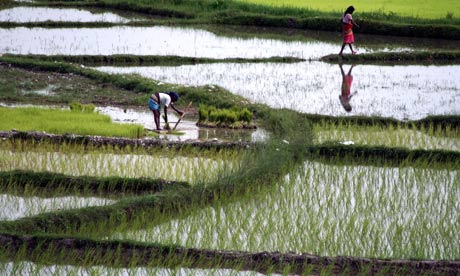
KATHMANDU, AUG 13 -
SANGAM PRASAIN
Paddy transplantation has been done on only 84 percent of the total
paddy fields as of August 10 compared to 100 percent last year, thanks
to poor monsoon.
Given most of the farming dependent on monsoon rains, poor rainfall coupled with chemical fertiliser shortage is likely to cut paddy production notably this year.
After good monsoon for the last two years, rainfall remained poor this year.
Officials at the Ministry of Agriculture Development hoped that the
transplantation would spill over until mid-August in some regions, with
forecast of some late August rainfalls.
However, transplantation across the country is expected to remain below
93 percent this season, which agro economists said is a huge loss for
the country’s agriculture sector.
As on August 10, the transplantation has been done on 1.28 million
hectares of land against 1.53 million hectares in the corresponding
period last year, a drop of 19.61 percent. “Definitely, our paddy
production will be affected this year,” said Krishna Prasad Pant, senior
agro economist at the Department of Agriculture.
This year, the country’s agriculture sector suffered two major setbacks
— acute chemical fertiliser shortage and late monsoon. Pant said the
drop in plantation means production will go down. Besides, the
unavailability of chemical fertilisers, a vital farm input, will also
play a key role in reducing productivity.
Ministry statistics show paddy transplantation on hills and mountain
regions stood at 90 percent and 86 percent, respectively compared to 100
percent a year ago. Paddy is cultivated on 356,222 hectares in hills
and 58,863 hectares in mountain region.
The plantation period in the hill and mountain regions has already been
over, while plantation will continue for some three-four days in some
places in Tarai, the ministry officials said. The Tarai region, which
constitutes of over 71 percent (865,234 hectare) paddy fields, has 81
percent transplantation rate.
In terms of development regions, transplantation in the mid- and
far-western regions has been done on 98 percent land. The far western
region has recorded 96 percent
transplantation. The eastern and central regions have the most
disappointing results. Paddy transplantation in these two regions has
been completed on only 75 percent and 74 percent of the total
paddy fields.
According to the ministry statistics, transplantation in Saptari,
Mohattari, Siraha and Dhanusha and has been done on 35 percent, 40
percent, 45 percent and 47 percent of the land, respectively. In these
districts, paddy is cultivated on 60,000, 34,776, 61,000 and 65,000
hectares of land, respectively.
“Rainfall has been extremely low in most of the Tarai districts
resulting in a low progress in paddy transplantation,” said Hemraj
Regmi, a senior statistician at the ministry. According to the
Meteorological Forecasting Division, these four Tarai districts suffered
a drought this monsoon.
However, paddy cultivation in Jhapa, Morang and Sunsari progressed
faster. Paddy transplantation in these districts has been done on 90
percent, 95 percent and 80 percent of the total fields. The figures were
at 75 percent, 60 percent and 50 percent, respectively, last week.
Posted on: 2012-08-13 09:11
Source:
http://kantipuronline.com/2012/08/13/business/84-percent-paddy-transplantation-so-far/358696.html